
|
|
  |
 |
 |
 |
 |
 |
 |
 |
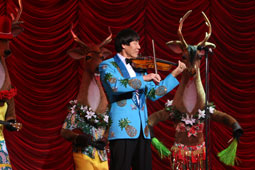 Just what is the Shoji Tabuchi Show that everyone
loving American music is raving about? At its heart is Branson USA's
first family of extraordinary musical entertainment....Shoji Tabuchi,
his beautiful wife Dorothy and delightful daughter Christina. The
family that plays, sings, and dances encompasses all the wholesome
values of truly great family entertainment. Yet the show rivals the
pure excitement of Las Vegas or New York. Just what is the Shoji Tabuchi Show that everyone
loving American music is raving about? At its heart is Branson USA's
first family of extraordinary musical entertainment....Shoji Tabuchi,
his beautiful wife Dorothy and delightful daughter Christina. The
family that plays, sings, and dances encompasses all the wholesome
values of truly great family entertainment. Yet the show rivals the
pure excitement of Las Vegas or New York.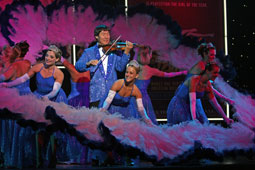 With his
sense of musical perfection, Shoji searched long
and hard for the right professional musicians to form his band. It is
with great pride and affection that he introduces each and every
member, all of whom have one or more degrees in music. Their repertoire
includes everything from country to classic, played with all the
subtlety or verve, as the music demands, of a gifted musical
organization. With his
sense of musical perfection, Shoji searched long
and hard for the right professional musicians to form his band. It is
with great pride and affection that he introduces each and every
member, all of whom have one or more degrees in music. Their repertoire
includes everything from country to classic, played with all the
subtlety or verve, as the music demands, of a gifted musical
organization.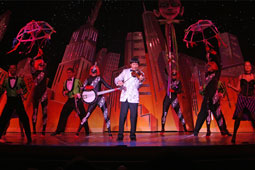 The superb
dancers are Dorothy's domain. Working with a renowned choreographer,
and long hours of rehearsals, she has brought the dance company to a
state of perfection that rivals any dance company in the world. Their
creativity ranges from dancing with twirling cowboy ropes to lively
polkas to dancing the Sugar Plum Fairy danced on toe during a special
Christmas performance. Since the days of the Old Testament, song has
been an expression of joy, uplifting the spirit. The company's
extraordinary vocalists exemplify that joy with lovely ballads, songs
of the 50's and 60's, gospel,...all to the toe-tapping delight of the
audience. The superb
dancers are Dorothy's domain. Working with a renowned choreographer,
and long hours of rehearsals, she has brought the dance company to a
state of perfection that rivals any dance company in the world. Their
creativity ranges from dancing with twirling cowboy ropes to lively
polkas to dancing the Sugar Plum Fairy danced on toe during a special
Christmas performance. Since the days of the Old Testament, song has
been an expression of joy, uplifting the spirit. The company's
extraordinary vocalists exemplify that joy with lovely ballads, songs
of the 50's and 60's, gospel,...all to the toe-tapping delight of the
audience.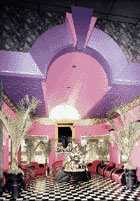 All is
showcased in a theatre that is a phenomenon in
itself...often called the "Showplace of Branson." Its decor is
reminiscent of the grand theatre palaces of the 1930's. Even the
restrooms have awed
visitors. All is
showcased in a theatre that is a phenomenon in
itself...often called the "Showplace of Branson." Its decor is
reminiscent of the grand theatre palaces of the 1930's. Even the
restrooms have awed
visitors.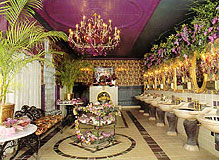 The
ladies' powder room is complete with wainscoting and
ceiling reproduced from the 1890's Empire Period. To the ladies
amazement, there are live cut orchids at every granite and onyx
pedestal sink. Add to all that stained and jeweled glass and
magnificent chandeliers! The
ladies' powder room is complete with wainscoting and
ceiling reproduced from the 1890's Empire Period. To the ladies
amazement, there are live cut orchids at every granite and onyx
pedestal sink. Add to all that stained and jeweled glass and
magnificent chandeliers! |
| The gentleman's lounge is no less imposing, with black lion head sinks imported from Italy, black leather chairs and a marble fireplace. The billiard room contains a hand carved mahogany billiard table, a viewing gallery, and a burled walnut mirror that was built in 1868. | 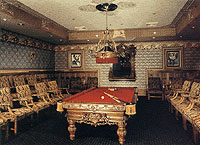 |
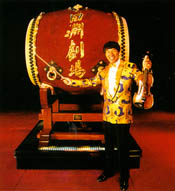 |
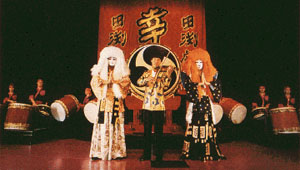
A recent addition to the show has been a
cherished project of Shoji's and Dorothy's, and brings to the American
people some of Shoji's native Japanese culture . . . the Taiko drums.
The word Taiko refers to the art of Japanese drumming, but
also means the Taiko drums themselves. The drums are not just
instruments, but rather they recreate "the origin of the spirit of the
Japanese people."
|
|
Reputedly,
Taiko was used originally to intimidate enemies on the
battlefield. Taiko also was once a symbol of the rural
community, and the limits of a village were defined, not by geography,
but by the furthest reach of the drums' sound. Taiko is still
used in Japanese religious ceremonies and is an important part of many
festivals. Taiko as it is performed today is a relatively new
phenomenon. It started in post-war Japan as a way to preserve tradition.
The "tomoe" design painted on the head of the drum is from the Japanese culture, which gives the scope of the universe. Their belief is the everything is the breadth of creation. The spiral comma-shape of the tomoe is the never ending, all-encompassing spiritual feeling of everything that is or was. |
|
||||
|
There are 25 drums of three different styles and sizes in our show. The largest, known as Odaiko, was hand carved by Asano Taiko of Japan. The smallest are called Shime-daiko and has a high-pitched sound. Our Nagado-daiko, the mid-size drums, were custom made by David Leong of Rolling Thunder Taiko. |
|
Chosen
to instruct our cast on the art of Taiko technique was Marco Lienhard. Marco is a world-class performer and
instructor of not only Taiko drumming, but also fue and shakuhachi,
which are traditional Japanese flutes. We feel very fortunate to have
him come to Branson to work with us.
|
 |